Residential Snow Removal vs Commercial Snow Removal: Which Market Is Better for New Contractors?
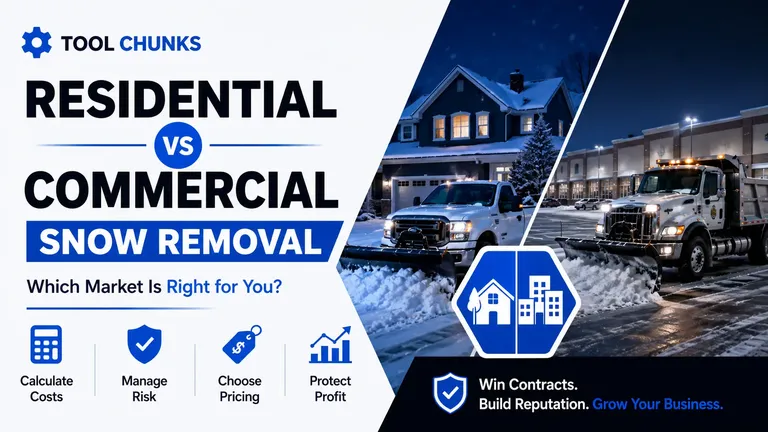

Commercial snow removal is often viewed as the pinnacle of the snow industry.
Large parking lots, multi-year contracts, and five-figure seasonal agreements make it easy to understand why. New contractors frequently assume that commercial work is automatically more profitable than residential snow removal.
After working in weather operations and later building snow and landscaping businesses in Montana, I've seen the opposite happen many times. Contractors purchase additional trucks, hire employees, and win commercial accounts only to discover that higher revenue doesn't always produce higher profits.
The truth is that residential and commercial snow removal are different business models. Each has advantages, risks, staffing requirements, equipment demands, and growth opportunities.
For most new contractors, residential snow removal offers the best path to profitability and operational experience. Commercial snow removal can create significant long-term growth, but it requires systems, capital, and management skills that many first-year operators have not yet developed.
Quick Verdict
If you're launching a snow removal business with one truck and limited capital, residential snow removal is usually the better starting point.
If you already have multiple trucks, reliable operators, adequate insurance coverage, and experience managing winter operations, commercial contracts may offer greater scalability.
The strongest snow removal companies often operate in both markets. They simply don't start there.
Residential vs Commercial Snow Removal at a Glance
| Factor | Residential Snow Removal | Commercial Snow Removal |
|---|---|---|
| Startup Cost | Lower | Higher |
| Equipment Requirements | Basic | Extensive |
| Revenue Per Customer | Lower | Higher |
| Profit Margins | Often Higher | Often Lower |
| Payment Speed | Faster | Slower |
| Liability Risk | Moderate | High |
| Staffing Requirements | Low | High |
| Contract Complexity | Simple | Complex |
| Route Management | Critical | Critical |
| Long-Term Growth | Moderate | High |
One of the biggest misconceptions in the industry is that commercial snow removal is simply residential snow removal on a larger scale.
It isn't.
The operational challenges are completely different.
What Residential Snow Removal Actually Looks Like
Residential snow removal generally includes:
-
Driveway plowing
-
Sidewalk clearing
-
Snow blowing
-
Ice control
-
De-icing walkways
-
Seasonal service agreements
-
Per-push snow removal services
Most homeowners care about reliability more than anything else.
They want to leave for work safely. They want to know their driveway will be cleared before they wake up. They want communication when weather conditions become severe.
The challenge isn't the work itself.
The challenge is efficiency.
Many first-year contractors focus exclusively on customer count. Experienced operators focus on route density.
A contractor servicing 25 homes in a single subdivision often generates more profit than a contractor servicing 50 homes spread across an entire city.
Travel time, fuel costs, loading equipment, and traffic all reduce productivity. During major snow events, route efficiency can determine whether a season is profitable or frustrating.
What Commercial Snow Removal Actually Looks Like
Commercial snow removal typically includes:
-
Parking lot plowing
-
Sidewalk maintenance
-
Salt applications
-
Anti-icing treatments
-
Snow stacking
-
Snow hauling
-
Site inspections
-
Weather monitoring
-
Service documentation
Commercial clients are not buying snow removal.
They're buying risk management.
Property managers, facility managers, and business owners care about:
-
Liability reduction
-
Response times
-
Documentation
-
Customer safety
-
Tenant access
-
Business continuity
A shopping center may lose customers if parking lots aren't maintained.
A medical facility may require continuous service during a storm.
An industrial facility may need loading docks accessible at all hours.
The expectations are significantly higher than those of a typical residential customer.
Not All Commercial Accounts Are Created Equal
One mistake new contractors make is treating all commercial properties the same.
In reality, each property type creates different operational challenges.
Retail Centers
Retail properties prioritize customer access and appearance. Frequent plowing and salting may be required throughout operating hours.
Medical Facilities
Medical properties often maintain some of the highest service expectations in the industry. Emergency access must remain available at all times.
Apartment Communities
Apartment complexes can be an attractive entry point into commercial work. However, vehicle traffic continues throughout the storm, making snow removal more difficult than many contractors expect.
Industrial and Distribution Facilities
Industrial properties prioritize operational continuity. Truck routes, loading docks, and employee access points often require specialized planning and equipment.
Understanding these differences is critical when evaluating commercial opportunities.
Startup Costs: Where the Gap Becomes Obvious
Many contractors underestimate the financial difference between residential and commercial operations.
A residential startup may require:
-
Pickup truck
-
Snow plow
-
Snow blower
-
Hand tools
-
Ice melt inventory
A commercial operation may require:
-
Multiple plow trucks
-
Salt spreaders
-
Skid steers
-
Loaders
-
Backup equipment
-
Additional insurance coverage
Property managers frequently ask:
"What happens if your primary truck breaks down during a storm?"
For residential routes, a temporary delay may be manageable.
For commercial properties, it can jeopardize the entire contract.
Commercial clients expect redundancy.
A Real-World Profitability Example
Let's compare two simplified but realistic scenarios.
Contractor A: Residential Route
42 seasonal residential accounts
Average seasonal contract value:
$700
Season revenue:
$29,400
Equipment:
-
One truck
-
One plow
-
One snow blower
Direct operating expenses:
Approximately $11,000
Estimated operating profit:
$18,400
Contractor B: Commercial Portfolio
One apartment complex
One retail center
Season revenue:
$43,000
Additional costs:
-
Salt applications
-
Sidewalk labor
-
Higher insurance premiums
-
Equipment redundancy
-
Additional administration
Direct operating expenses:
Approximately $26,000
Estimated operating profit:
$17,000
The commercial portfolio generated nearly 50% more revenue.
The residential route generated slightly more profit.
This isn't always the outcome, but it illustrates why revenue alone can be misleading.
Revenue vs Profit: The Most Expensive Lesson in Snow Removal
Many contractors chase large contracts because they look impressive.
Unfortunately, large contracts often introduce:
-
Higher labor costs
-
Additional insurance requirements
-
Salt expenses
-
Equipment wear
-
Administrative burdens
I've seen contractors win their first commercial account and spend the entire winter wondering why cash flow remained tight despite strong revenue.
Revenue pays attention to growth.
Profit determines whether the business survives.
Cash Flow Challenges Most Beginners Overlook
Cash flow is one of the biggest differences between residential and commercial work.
Residential customers often:
-
Prepay for seasonal service
-
Pay monthly
-
Pay immediately after service
Commercial customers commonly operate on:
-
Net-30
-
Net-45
-
Net-60 payment terms
Meanwhile, expenses continue immediately:
-
Payroll
-
Fuel
-
Salt
-
Equipment repairs
-
Insurance
A contractor can be profitable on paper while struggling to pay bills.
This reality surprises many operators entering commercial snow removal for the first time.
Pricing Models: Residential vs Commercial
Residential contractors typically use:
-
Per-push pricing
-
Seasonal contracts
-
Monthly payment plans
Commercial contractors commonly use:
-
Seasonal agreements
-
Per-event pricing
-
Trigger-depth pricing
-
Time-and-materials billing
-
Zero-tolerance contracts
The pricing structure directly affects profitability.
Contractors who don't fully understand pricing mechanics often underbid work and create financial problems before the season begins.
Understanding local market rates is essential before building either residential or commercial proposals.
Staffing, Labor, and Subcontractors
The transition from residential to commercial work is usually a labor challenge before it's an equipment challenge.
Residential operations can often be managed by:
-
Owner operators
-
Family members
-
Small crews
Commercial operations may require:
-
Multiple drivers
-
Sidewalk crews
-
Salt operators
-
Supervisors
-
Subcontractors
Subcontractors play a major role in the commercial snow industry.
Many established contractors rely on subcontractors during major snow events to maintain service levels and provide equipment redundancy.
A backup truck has little value if nobody is available to operate it.
Three Mistakes That Destroy First-Year Snow Removal Profits
After years in the industry, three mistakes appear repeatedly.
1. Accepting Poorly Located Accounts
Route density matters more than customer count.
2. Underestimating Salt and Material Costs
Material expenses can significantly impact profitability during active winters.
3. Ignoring Equipment Depreciation
Many contractors calculate fuel costs but fail to account for equipment wear and replacement costs.
These mistakes affect both residential and commercial operations.
Liability and Documentation
Snow removal is fundamentally a liability management business.
Every service visit should be documented.
Professional contractors track:
-
Arrival times
-
Departure times
-
Weather conditions
-
Salt applications
-
Site inspections
-
Customer communications
Slip-and-fall claims can occur months after a service event.
Proper documentation often becomes the strongest defense.
Regional Snowfall Matters More Than Most Articles Admit
Advice that works in Montana may not work in Pennsylvania, Ohio, Michigan, or Virginia.
Snowfall frequency, accumulation patterns, and winter severity influence:
-
Pricing
-
Contract structures
-
Equipment investments
-
Staffing needs
A seasonal contract that performs well in one region can become unprofitable in another.
Historical snowfall data should always influence contract decisions.
Which Market Is Better for New Contractors?
For most startups, residential snow removal remains the better training ground.
It allows contractors to:
-
Learn pricing
-
Build cash flow
-
Develop route efficiency
-
Understand winter operations
-
Gain customer service experience
Commercial snow removal becomes attractive once equipment, staffing, systems, and financial reserves have matured.
Winning a commercial contract is relatively easy.
Servicing it profitably during a severe winter is where experience matters.
Final Recommendation
If you're new to the industry, focus on building a profitable residential route before aggressively pursuing commercial accounts.
Learn your costs. Track labor hours. Monitor fuel consumption. Understand equipment wear. Develop efficient routes and dependable operating procedures.
Commercial snow removal can become an excellent growth opportunity, but growth only creates value when it remains profitable.
The contractors who build durable snow businesses aren't necessarily the ones with the largest contracts.
They're the ones who understand their numbers, manage risk effectively, maintain strong documentation, and consistently deliver reliable service during the most challenging weather conditions of the year.