Subcontracting vs Self-Performing Snow Removal: Which Model Builds a Stronger Business?
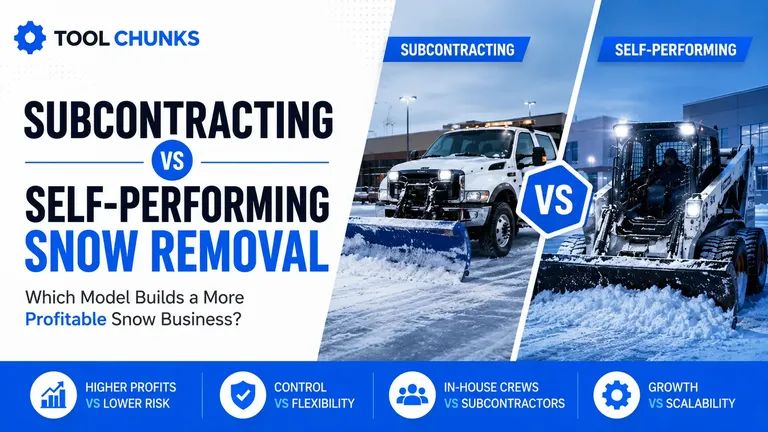

For snow removal contractors, few decisions have a bigger impact on profitability, growth, and customer retention than choosing between subcontracting and self-performing services.
The short answer is straightforward:
Self-performing snow removal usually delivers higher profit margins, greater quality control, and stronger long-term business value. Subcontracting allows faster growth, lower upfront investment, and greater flexibility.
The challenge is that neither model is universally better.
The right choice depends on route density, contract type, labor availability, equipment costs, and growth objectives. In many cases, the most successful snow companies use a combination of both.
After years in the snow and landscaping industries, I've found that contractors often focus on revenue when making this decision. In reality, operational control and route efficiency usually have a much greater impact on long-term profitability than total contract volume.
Quick Comparison
| Factor | Self-Performing | Subcontracting |
|---|---|---|
| Profit Potential | High | Moderate |
| Startup Cost | High | Low |
| Quality Control | Excellent | Variable |
| Growth Speed | Moderate | Fast |
| Labor Management | Direct Responsibility | Reduced Responsibility |
| Equipment Investment | Significant | Minimal |
| Customer Experience | Consistent | Depends on Subcontractor |
| Long-Term Business Value | Strong | Moderate |
For contractors focused on building a scalable operating company, self-performing often provides the strongest foundation.
For contractors expanding rapidly across multiple markets, subcontracting can be an effective growth strategy.
Understanding the Difference
Self-Performing Snow Removal
A self-performing contractor uses company-owned or leased equipment and employs its own operators.
The company directly manages:
-
Snow plowing
-
Sidewalk clearing
-
Salt and deicing applications
-
Equipment maintenance
-
Dispatching
-
Route planning
-
Service documentation
Every aspect of service remains under the company's control.
Subcontracting Snow Removal
Under a subcontracting model, the contractor secures commercial or residential accounts but hires independent operators to perform the work.
Subcontractors often provide their own:
-
Trucks
-
Plows
-
Skid steers
-
Loaders
-
Salt spreaders
-
Labor
The primary contractor manages the client relationship while subcontractors execute the work.
This approach reduces capital requirements but introduces additional operational variables.
Profitability: What Actually Drives Margins
One of the biggest misconceptions in the industry is that subcontracting automatically increases profits because overhead is lower.
In reality, profit margins depend heavily on route density and equipment utilization.
Consider a contractor managing a $100,000 seasonal commercial contract.
Self-Performing Example
The contractor owns the equipment and employs the operators.
Typical gross margin range:
40%–60%
Margins improve when:
-
Routes are geographically concentrated
-
Equipment remains productive throughout storms
-
Labor is scheduled efficiently
-
Salt purchasing is optimized
Subcontracting Example
The contractor assigns service to subcontractors.
Typical gross margin range:
15%–35%
While equipment costs are lower, a substantial portion of revenue is paid to subcontractors.
This explains why many contractors begin with subcontracting but transition toward self-performing operations as route density improves.
The Importance of Route Density
If there is one metric many new contractors overlook, it is route density.
A contractor with twenty properties spread across an entire city may generate impressive revenue but struggle with profitability.
Another contractor servicing ten properties within a two-mile radius may earn significantly higher margins.
Every mile traveled between sites creates:
-
Fuel costs
-
Labor costs
-
Vehicle wear
-
Delayed response times
The most profitable routes often aren't the largest routes. They're the densest.
Over the years, I've seen contractors add accounts simply because they were available, only to discover that the additional travel time reduced overall profitability.
A larger route isn't always a better route.
Quality Control and Customer Retention
Most property managers don't care whether snow removal is self-performed or subcontracted.
They care about results.
Can tenants safely access the property?
Was the lot cleared before business hours?
Were slippery conditions addressed promptly?
This is where self-performing operations typically hold an advantage.
When employees are trained under the same standards, service tends to be more consistent. Site-specific instructions are easier to follow, and supervisors can address problems immediately.
Subcontracting introduces additional uncertainty.
Many subcontractors provide excellent service. The challenge is maintaining consistency across multiple operators, equipment types, and service areas.
A site may receive outstanding service during one storm and noticeably different service during the next.
That inconsistency can damage client confidence over time.
What Happens During a Major Snow Event?
Business models are rarely tested during a three-inch snowfall.
They are tested during the largest storm of the season.
Imagine a contractor responsible for fifty commercial properties receives eighteen inches of snow over twenty-four hours.
Self-Performing Operations
Management can:
-
Reassign crews
-
Prioritize critical sites
-
Adjust routes
-
Deploy backup equipment
-
Communicate directly with operators
The company remains in control of the response.
Subcontracted Operations
The contractor depends on third-party operators fulfilling their commitments.
Potential issues include:
-
Equipment breakdowns
-
Communication delays
-
Labor shortages
-
Scheduling conflicts
-
Competing customer priorities
One lesson many contractors learn the hard way is that subcontractors often serve multiple clients.
A subcontractor who services ten of your sites may also be servicing twenty sites for another company.
This rarely creates problems during minor events.
During major storms, however, priorities can shift quickly.
The greatest risk associated with subcontracting is not losing a bid. It's losing operational control when conditions become difficult.
Contract Types Matter More Than Most Contractors Realize
The effectiveness of each model often depends on the type of contract being serviced.
Seasonal Contracts
Seasonal contracts reward efficiency.
The contractor receives a fixed amount regardless of snowfall totals.
Because profitability depends heavily on operational performance, self-performing often has an advantage.
Per-Push Contracts
Per-push agreements create more flexibility.
Subcontracting can work well because labor and equipment expenses generally increase alongside revenue.
Time-and-Materials Contracts
These agreements reduce some operational risk because billing is based on actual work performed.
Both models can be effective depending on labor availability and management capacity.
The contract structure should influence your operating model—not the other way around.
A Real-World Growth Scenario
Consider a contractor servicing fifteen commercial properties using subcontractors.
Initially, the arrangement works well. Capital requirements remain low, and the business grows quickly.
Over time, however, ten of those properties become concentrated within a three-mile service area.
At that point, purchasing two dedicated plow trucks may become financially attractive.
Travel time decreases.
Scheduling becomes easier.
Service consistency improves.
Profit margins often increase.
This transition is common throughout the industry.
Many successful companies use subcontracting as a growth tool before gradually bringing key routes in-house.
Why Hybrid Models Often Produce the Best Results
The debate is often framed as subcontracting versus self-performing.
In practice, many established contractors use both.
A hybrid model may involve:
-
Self-performing premium commercial accounts
-
Self-performing high-density routes
-
Subcontracting distant properties
-
Using subcontractors during major storm events
-
Maintaining backup subcontractor relationships
This structure combines control with flexibility.
The company protects its most valuable accounts while preserving the ability to scale during peak demand.
Many mature snow businesses eventually arrive at some variation of this model.
Common Mistakes Contractors Make
Regardless of the operating model, several mistakes appear repeatedly.
Expanding Too Quickly
Winning contracts is easier than servicing them consistently.
Growth should follow operational capacity.
Selecting Subcontractors Based Solely on Price
The lowest-cost subcontractor often becomes the most expensive when service failures occur. So, estimate properly before making any decision.
Buying Equipment Too Early
Equipment should support route density, not future hopes.
Failing to Maintain Backup Resources
Every truck breaks down eventually.
Every operator becomes unavailable at some point.
Redundancy is essential in snow operations.
Ignoring Route-Level Profitability
Revenue is important.
Profitability is what sustains a business.
Contractors should evaluate individual routes, not just total annual sales.
Long-Term Business Value
Contractors planning to sell their business in the future should consider how operating models affect valuation.
Self-performing companies typically build:
-
Equipment assets
-
Workforce infrastructure
-
Operating systems
-
Service expertise
-
Stronger brand control
Subcontractor-heavy companies often build:
-
Customer relationships
-
Management systems
-
Geographic reach
-
Vendor networks
Both models can be successful.
However, businesses with repeatable systems and direct operational control often command stronger valuations.
Final Recommendation
For contractors focused on maximizing profit margins, strengthening customer relationships, and building long-term enterprise value, self-performing snow removal is usually the better choice.
For companies entering new markets, preserving capital, or expanding rapidly across large geographic areas, subcontracting can provide advantages that would be difficult to achieve through owned resources alone.
The most successful snow contractors rarely view this as an all-or-nothing decision.
They self-perform where quality and profitability matter most and subcontract where flexibility creates strategic value.
At the end of the day, the best model is the one that allows your company to deliver consistent service during the worst storm of the season—not just during an average winter.